UML Diagrams
The Unified Modeling Language (UML) is a family of graphical notations, backed by single meta-model, that help in describing and designing software systems, particularly software systems built using the object-oriented (OO) style.
Sequence Diagram
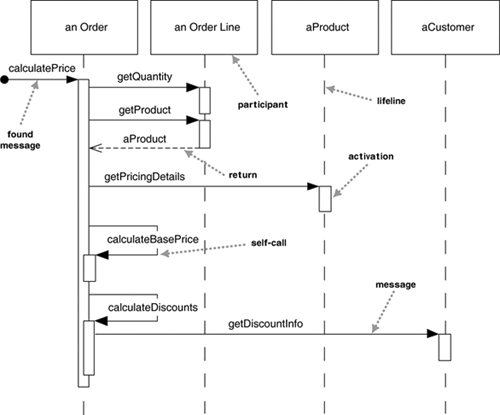
Interaction diagrams describe how groups of objects collaborate in some behavior. The UML defines several forms of interaction diagram, of which the most common is the sequence diagram.
Typically, a sequence diagram captures the behavior of a single scenario. The diagram shows a number of example objects and the messages that are passed between these objects within the use case.
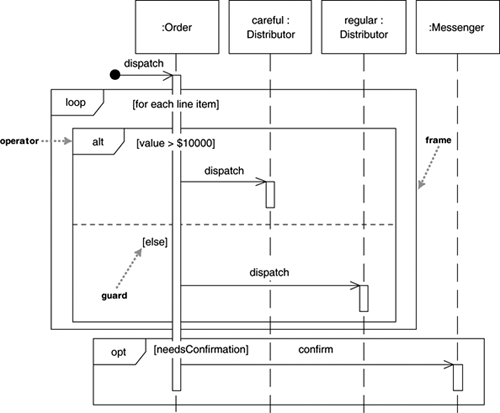
A common issue with sequence diagrams is how to show looping and conditional behavior. The first thing to point out is that this isn’t what sequence diagrams are good at. If you want to show control structures like this, you are better off with an activity diagram or indeed with code itself. Treat sequence diagrams as a visualization of how objects interact rather than as a way of modeling control logic.
That being said, there are ways to show conditionals and loops in a sequence diagram. The following figure shows a sequence diagram for the following pseudo-code:
procedure dispatch
  foreach (lineitem)
    if (product.value > $10K)
      careful.dispatch
    else
      regular.dispatch
    end if
  end for
  if (needsConfirmation) messenger.confirm
end procedure
Activity Diagram
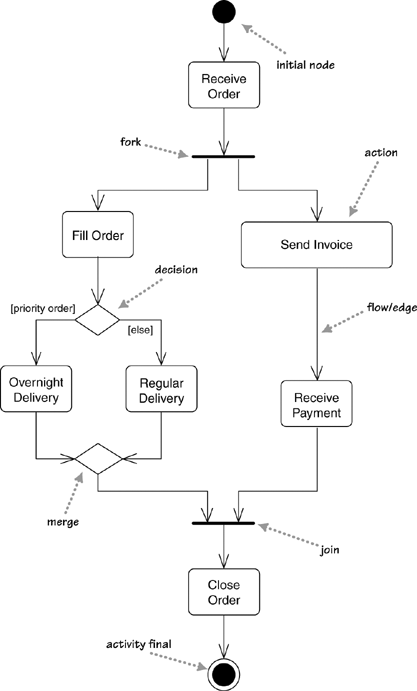
Activity diagrams are a technique to describe procedural logic, business process, and work flow. In many ways, they play a role similar to flowcharts, but the principal difference between them and flowchart notation is that they support parallel behavior.
Source: UML Distilled by Martin Fowler